
What Is Microsoft Fabric Lakehouse? How It Works, Benefits and a Real Example
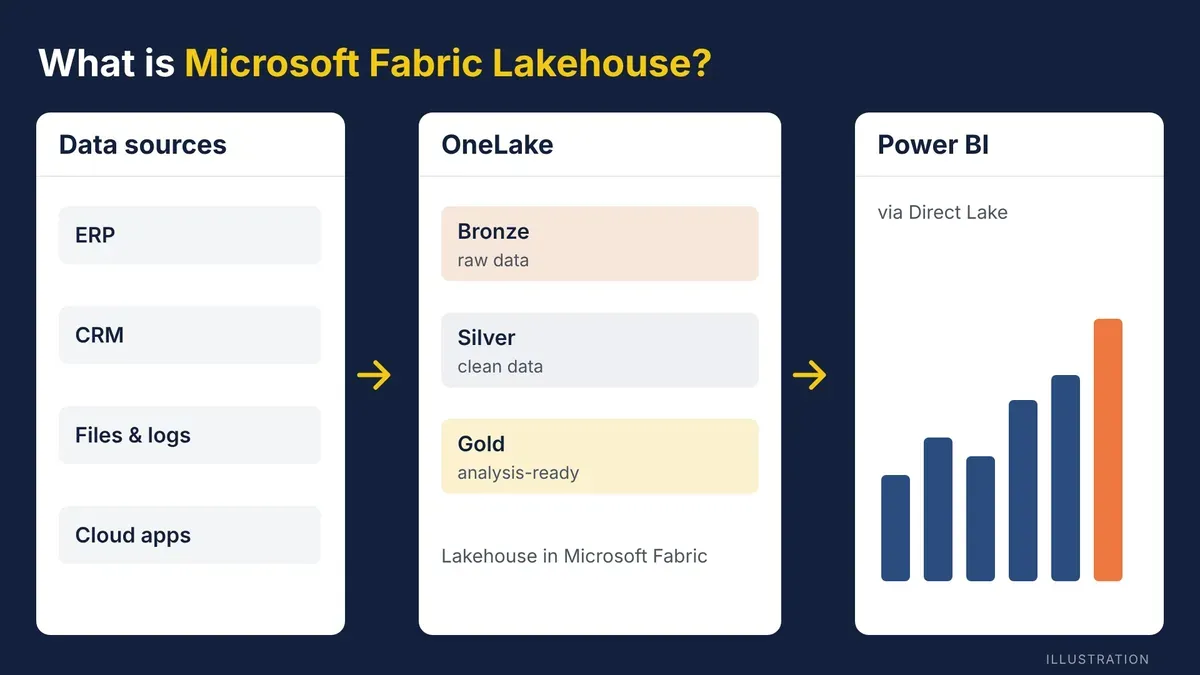
Microsoft Fabric Lakehouse is the data store in Microsoft Fabric that combines a data lake and a data warehouse on one platform. Raw data from many sources is stored in an open format, then turned into tables that can be queried with SQL and read directly by Power BI.
In a typical Power BI setup, each report prepares its own data in Power Query, so the same transformations are often built again and again. In a Fabric Lakehouse, the data is prepared once, in one place, and shared by every report.
OneLake: one store for every team
All the data in a Fabric Lakehouse lives in OneLake, Microsoft Fabric's single storage layer. Tables are stored in the open Delta format. Data engineering, BI and data science teams can use the same data without copying it or moving it to another system.
How Microsoft Fabric Lakehouse works
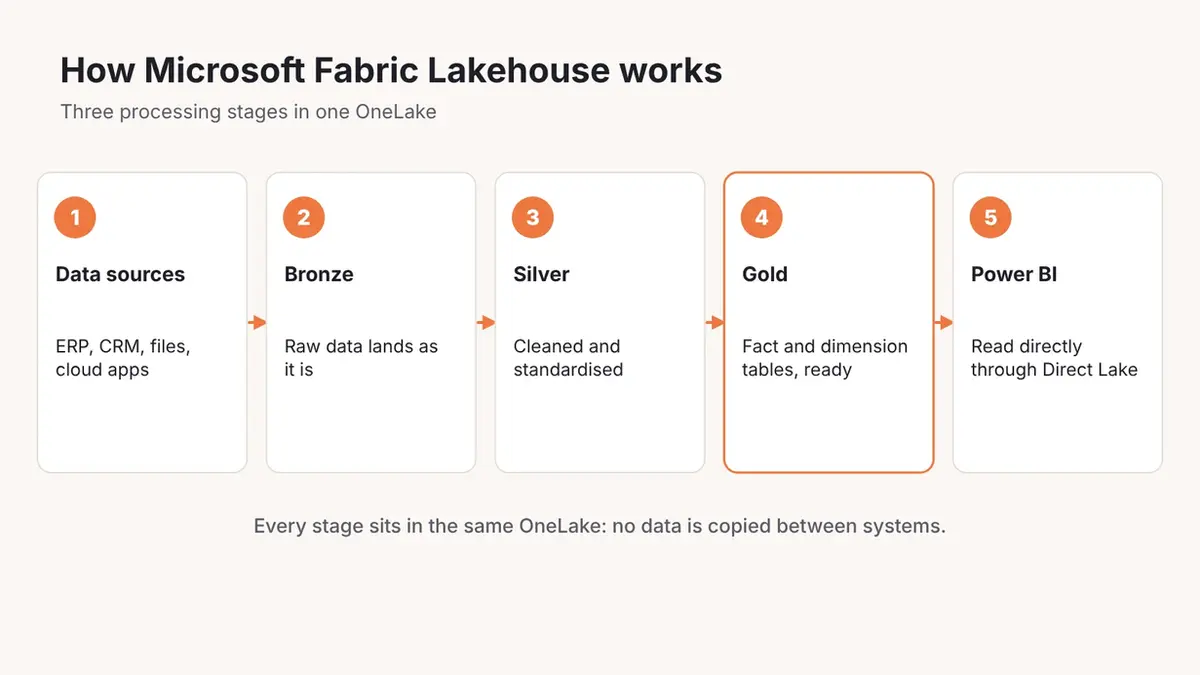
The most common pattern is three processing stages, often called the medallion architecture:
- Raw data (bronze): data from ERP, CRM, files and other sources lands as it is, through Data Factory pipelines or notebooks.
- Clean data (silver): the data is cleaned, standardised and joined, for example product codes that differ between systems are aligned.
- Analysis-ready data (gold): the data is shaped into fact and dimension tables ready for reporting.
All three stages sit in the same OneLake, so data is not copied between systems as it is in a conventional data warehouse architecture. Every lakehouse also comes with a SQL analytics endpoint, so analysts can query its tables with SQL.
Direct Lake: Power BI reads straight from the lakehouse
Power BI can connect to lakehouse tables in Direct Lake mode. The data is read directly from OneLake without first being imported into the semantic model, so reports stay as fast as import mode without waiting for a long scheduled refresh to show the latest data.
When does a company need a Fabric Lakehouse?

The signs are close to those in when to upgrade a data warehouse, with a few specific to Fabric:
- Many products or business lines: each line needs its own reports, but the data must be comparable in one model.
- Varied data sources: structured data from transaction systems mixed with raw files, logs or data from cloud applications.
- Power BI models getting heavy: dataset refreshes take longer as data volumes and transformations grow.
- Already on Microsoft 365 and Power BI: Fabric builds on the licences, security and skills the team already has.
Benefits of Microsoft Fabric Lakehouse
- One source of data for every team: BI, data engineering and data science use the same data without duplicates.
- New data sources added faster: the existing pipeline is extended, not rebuilt for every new product or branch.
- More responsive dashboards: Direct Lake reduces the dependence on long dataset refreshes.
- One platform, one licence: data integration, storage and reporting are managed in one Microsoft service on a capacity model.
Example: a pharmaceutical product portfolio
BI Solusi implemented a Fabric Lakehouse for a multinational pharmaceutical company. A dashboard first built for a single product launch was extended into a BI platform for the whole portfolio, with the same KPI definitions for every product. A new product is now simply added to the existing pipeline. Read the full case study.
Frequently asked questions
What is the difference between a Fabric Lakehouse and a Fabric Warehouse?
Both are part of Microsoft Fabric and store data in OneLake. A lakehouse suits raw and varied data processed with Spark or notebooks, with SQL access for reading. A warehouse suits teams that want to work fully in SQL, including writing and changing data. Many projects use both.
Do existing Power BI reports have to be rebuilt?
Not necessarily. Existing reports can be moved in stages to a new semantic model on top of the lakehouse, and they can look the same to users.
Can a Fabric Lakehouse read data from Snowflake or other systems?
Yes. Fabric can load or replicate data from many sources, including Snowflake, SQL Server and cloud applications. The two platforms are compared in Snowflake vs Microsoft Fabric.
Next steps
See BI Solusi's Microsoft Fabric services, or tell us about your data in a free consultation. As part of Kitameraki, an Official Microsoft Partner, we can also supply the Fabric licences.


