
Snowflake vs Microsoft Fabric: Which One Fits Your Company?
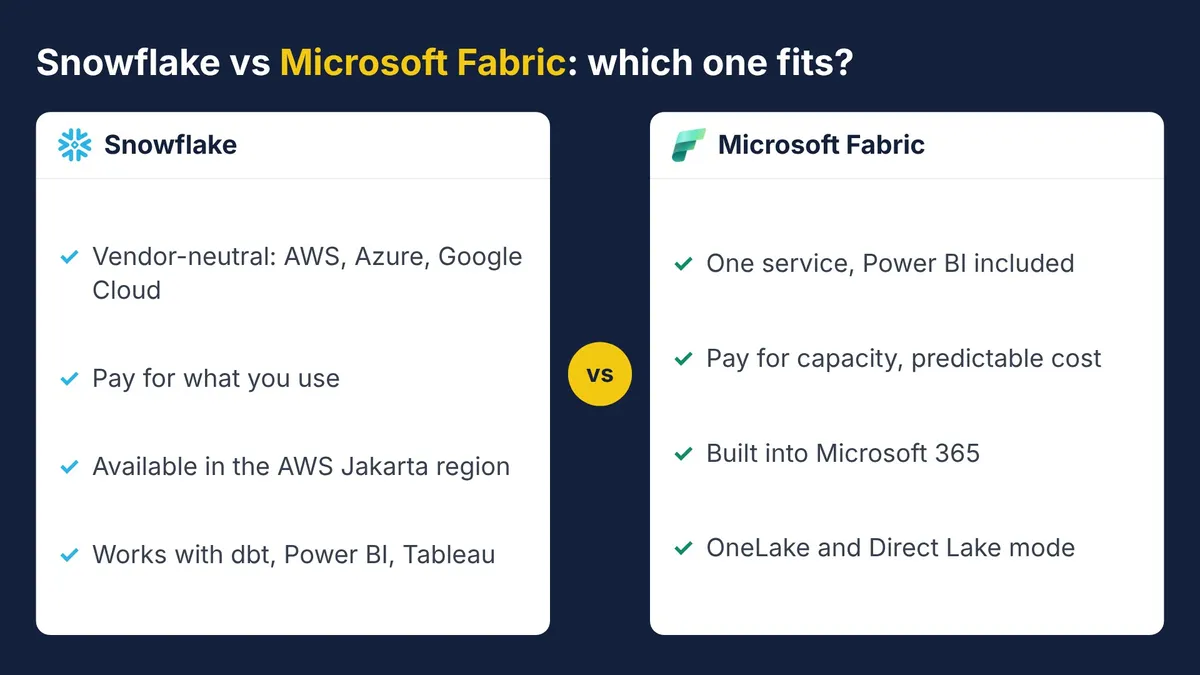
Snowflake and Microsoft Fabric are both cloud data platforms, but they take different approaches. Snowflake is a data warehouse that works with any cloud and any BI tool. Microsoft Fabric is Microsoft's platform that brings data integration, storage and Power BI together in one service.
Both can be a reliable foundation for reporting. The right choice depends on your systems, licences, data volumes and team. This article compares the two and gives a practical guide to choosing.
Snowflake at a glance
Snowflake is a data warehouse that runs on AWS, Azure or Google Cloud, including the AWS Jakarta region. Storage and compute are separate: each team can use its own "virtual warehouse", and you pay for compute while it runs. Snowflake works with Power BI, Tableau, dbt and most data tools. The full explanation is in our article what is Snowflake.
Microsoft Fabric at a glance
Microsoft Fabric brings several components together in one service: Data Factory to load data, OneLake as a single storage layer, lakehouses and warehouses to process data, and Power BI for reporting. Fabric uses a capacity model: the company buys a set capacity that all these components share.
Snowflake and Microsoft Fabric compared
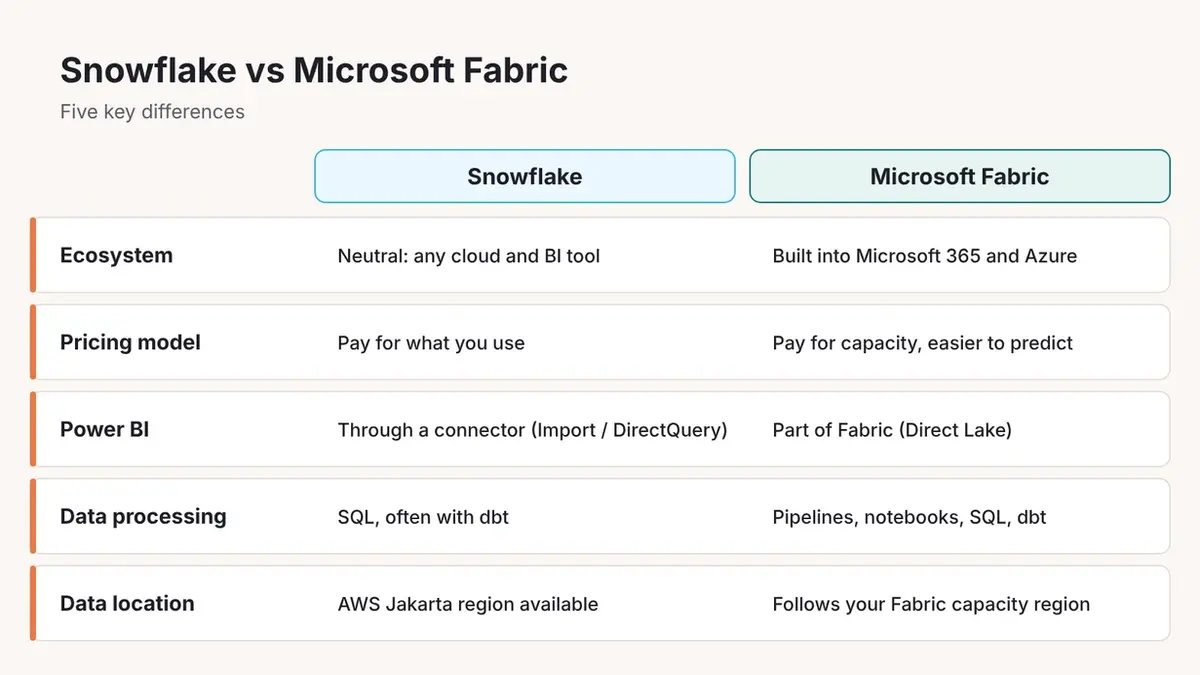
1. Ecosystem
- Snowflake: vendor-neutral. A good fit if the company uses several clouds or several BI tools, for example Power BI in one department and Tableau in another.
- Microsoft Fabric: strongest when the company already uses Microsoft 365, Azure and Power BI. Sign-in, security and licensing build on what is already in place.
2. Pricing model
- Snowflake: pay for what you use. Storage is billed by data volume, compute by the time virtual warehouses run. Flexible, but it needs monitoring so costs do not grow unchecked.
- Microsoft Fabric: pay for capacity. Costs are easier to predict, but the capacity must be sized correctly: too small is slow, too large is expensive.
3. Power BI integration
- Snowflake: Power BI connects through the Snowflake connector, in Import or DirectQuery mode. It works well and is widely used.
- Microsoft Fabric: Power BI is part of Fabric. Reports can read data directly from OneLake in Direct Lake mode, with no extra copy of the data.
4. Data processing
- Snowflake: processing is usually done in SQL, often combined with dbt so every transformation is versioned, tested and documented.
- Microsoft Fabric: offers pipelines, dataflows, notebooks and SQL in one environment. dbt can also be used with Fabric.
5. Data location
- Snowflake: can be hosted in the AWS Jakarta region.
- Microsoft Fabric: follows the region of the Fabric capacity you choose. Check that an Indonesian region is available for your capacity before deciding.
How to choose: a practical guide
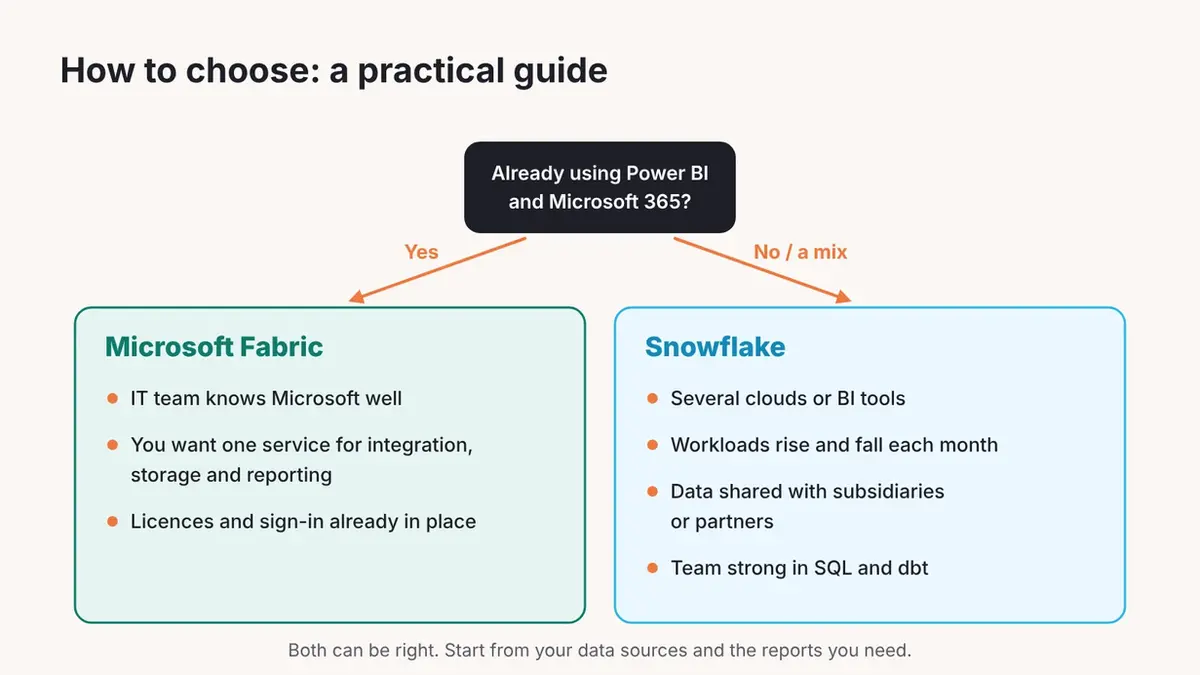
Microsoft Fabric is often the natural choice if:
- The company already uses Power BI and Microsoft 365.
- The IT team knows the Microsoft ecosystem well.
- You want one service for data integration, storage and reporting.
Snowflake is often the better fit if:
- The company uses several clouds or several BI tools.
- Data volumes are large and workloads rise and fall through the month.
- You need to share data with subsidiaries or partners.
- The data team is strong in SQL and wants to use dbt.
Neither choice is wrong. The more common mistake is choosing a platform before understanding the data sources and the reports the business really needs.
Questions to answer before choosing
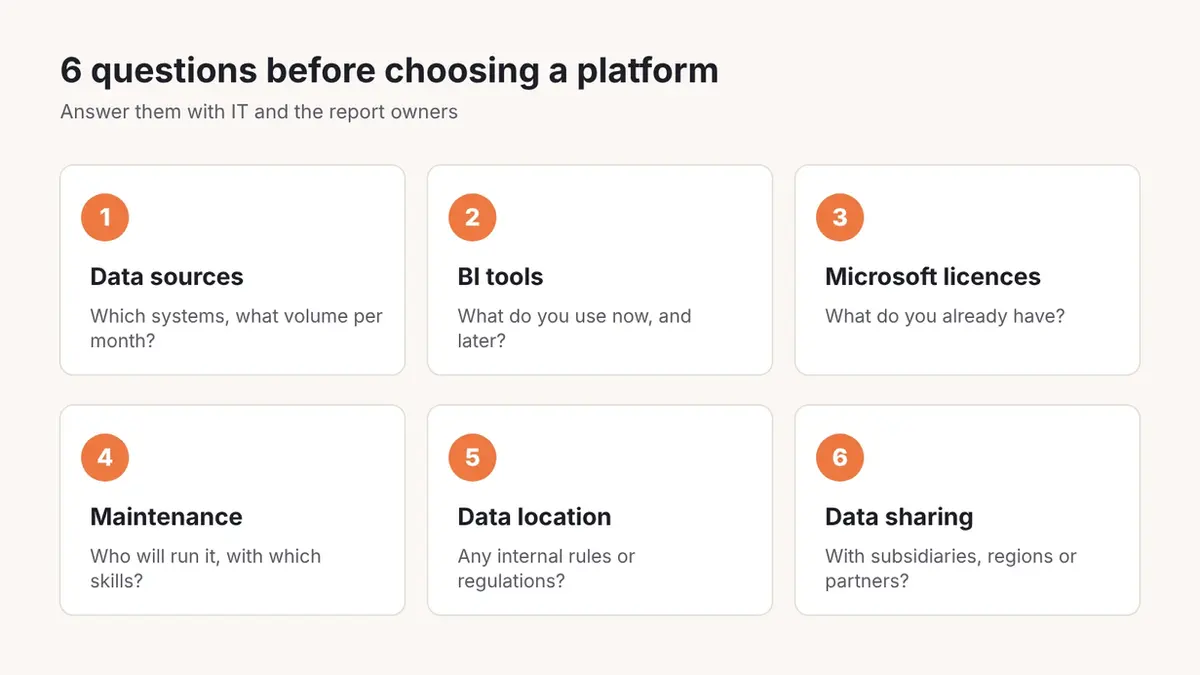
Before comparing features, answer these questions with IT and the report owners:
- Which systems are the data sources, and what is the data volume per month?
- Which BI tools are already in use, and will they stay?
- Which Microsoft licences does the company already have?
- Who will run the platform after the project, and what skills do they have?
- Are there internal rules or regulations on where data must be stored?
- Does data need to be shared with subsidiaries, regional offices or partners?
The answers usually point to one of the two platforms. If you are still unsure, start with one reporting area, such as finance or sales, and expand step by step.
Our experience
BI Solusi works with both platforms. On Snowflake, we have built data platforms with Snowflake and dbt for two pharmaceutical companies, in Jakarta and Singapore. As part of Kitameraki, an official Microsoft Partner, we also implement Microsoft Fabric and can supply its licences. So our recommendation starts from your company's needs, not from one vendor.
Frequently asked questions
Can Snowflake and Microsoft Fabric be used together?
Yes. Fabric can read data from Snowflake, so a company can keep Snowflake as its data warehouse and use Power BI in Fabric for reporting.
Which one is cheaper?
It depends on how you use it. Snowflake bills by usage, while Fabric bills a fixed capacity. For workloads that rise and fall, usage-based billing can cost less. For steady workloads and teams already on Power BI, capacity billing is easier to predict.
How long does a migration from SQL Server to either platform take?
It depends on the scope and the number of data sources. A simple project can be running within a month. Our typical Snowflake and dbt project takes about three months, with the existing reports kept running during the migration.
Next steps
See BI Solusi's Snowflake implementation services and Microsoft Fabric services, or tell us what you need in a free consultation.


